Index

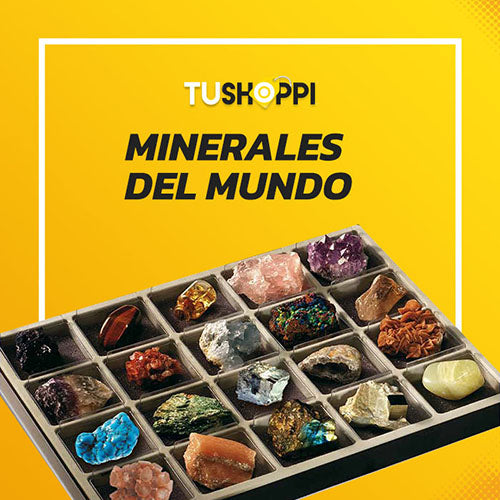
There's certainly one collection that fills us with emotion: the "Minerals of the World." National Geographic launched this fascinating collection, the only one that offers you authentic pieces collected by specialists from around the world.
For over 30 years, our experts have traveled the world searching for and studying the geological wonders of each region. Thanks to their work, we now have this collection of authentic minerals and gems from all five continents.
1. A unique collection
Only this collection offers you authentic pieces collected by our specialists from around the world. Imagine traveling to Brazil, China, or Madagascar and finding the most fascinating minerals and gems you've ever seen. Now imagine holding them in your hands and observing them up close, admiring their colors, their astonishing textures, and their surprising shapes.
The most fascinating gems and minerals in the Earth's crust: amethyst, rose quartz, agate, magnetite, tiger's eye, lapis lazuli, and many more.
Accompanied by fascicles and cards to learn how to identify them and learn how they're made and where to find them. With exclusive storage boxes specially designed for the collection, and complimentary card and fascicle binders. Incredible, isn't it?
With the booklets and sheets that accompany each mineral, you'll learn how to identify them and discover how they were formed, their characteristics, where they are found, and their hidden history. You'll also learn much more: what the Earth is like inside and out, how tectonic plates move, why volcanoes arise... A unique journey to the center of the Earth following the most important mineralogical routes.
2. National Geographic Research
For more than 30 years, National Geographic experts have traveled the world searching for and studying the geological wonders of each region. Thanks to their work, we now have this collection of authentic minerals and gems from all five continents.
Since 1888, the National Geographic Society has funded more than 12,000 research, exploration, and conservation projects worldwide. A portion of the proceeds from this collection support the National Geographic Society's nonprofit work in conservation, exploration, research, and education.
3.-What are minerals and gems?
But first, we must ask ourselves: What are minerals and gems? What are their differences? A mineral is a natural, homogeneous, inorganic substance with a defined chemical composition (within certain limits). It is found on the surface or in the various layers of the Earth's crust.
A gem, also called a precious stone, is a rock or mineral that, when cut and polished, can be used in jewelry or artistic objects. Others are man-made using resin and pigments.
We have a wide variety of different sizes, shapes, and textures on our planet, which amaze us year after year as we discover them. That's why it's so incredible to have the most important pieces ever discovered in a single collection.
4. Precious stones
More than 4,000 natural minerals, solid substances of inorganic origin with characteristic chemical compositions and crystalline structures, have been found on our planet. They are composed of molecules arranged in an orderly manner with repeating three-dimensional patterns.
Minerals form through various processes, such as sedimentation from magma or precipitation from solution. Mineral particles are usually small, having formed in confined areas such as lava flows or among sediments. Crystals found in geodes and other rocks are relatively uncommon.
Rocks themselves are made up of a mixture of minerals. Both rocks and minerals influence the formation of relief and form natural elements such as gold, tin, marble, and granite.
Silicates, including quartz, mica, olivine, and precious minerals such as emeralds, are the most common minerals and the largest component of rocks. Oxide, sulfate, sulfide, carbonate, and halide minerals form another important class of minerals.
Minerals and gems are classified according to their physical properties such as hardness, luster, color, density, and magnetism. They are also identified by the way they break or by the mark they leave when the "stripe method" is applied.
5. How many editions does the collection consist of?
The complete collection is made up of 100 deliveries (100 minerals + 100 fascicles + 100 groups of tokens) that you will find every two weeks until delivery 4, and week by week from delivery onwards.
6. First 2 editions
1st Delivery: GOLD + fascicle + tokens
With just one gram of gold, a wire 2,500 m long can be formed and cover an area of 2,000 m2, since sheets with a thickness of less than one-tenth of a micrometer can be obtained.
2nd Delivery: ROSE QUARTZ + fascicle + cards
Considered the gem of love and friendship, this variety of quartz discolors when heated, and turns black when exposed to X-rays.
7. Where can I get the collection?
You can find it starting August 17th at your favorite retailer, or you can purchase it in our online store and discover all the collections we have for you. https://tushoppi.com.mx/
We're definitely fascinated by this collection, and we think you'll love it too. Remember, in addition to each mineral, the third installment of the collection includes a free storage box, so you can stay tuned and enjoy this incredible benefit.
The booklets and sheets in the collection have been developed by expert speleologists, geologists, and mineralogists. With them, you'll learn all the secrets of mineralogy and discover why it has fascinated humanity since the beginning of time.
Now it's your turn to tell us in the comments what you think of this incredible National Geographic collection and if you'll be buying the full collection like us.